I was on a flight back from San Francisco last week. I was coming home from working with a Fortune 1000 client on improving their sales and marketing integration. On the flight, I happen to sit next to a person who was a professor of art history at a local Philadelphia university. She was amazingly well traveled. Had been all over the world and has interacted with dozens upon dozens of different cultures and societies.
I was in awe of her experiences and it made my life’s travels seem so small.
She asked me what I do for a living. So I gave her my 30-second elevator response. I expected her eyes to roll over and to immediate disengage me. She did the opposite. She started to relate what I do for a living to some of her own experiences. Here was the learning moment for me.
Like countries, all companies have their own culture. Being able to learn the culture, adapt to the culture and to engage at a human level that brings together cultures of independent groups like sales and marketing was how she related my role to her experience . And she’s right. Sales and marketing integration is not just about aligning content, messaging, technology, delivering better leads, etc. It’s also about understanding each other’s culture, needs, points of view – so that collaboration and ultimately teamwork is achieved. This is best stated as – aligning the human side of sales and marketing.
A company can purchase the best marketing automation technology, deliver the best leads and have an aligned communication plan, but in the end, it’s about teamwork and the interaction of human beings in the achievement of common goals. Do not forget culture and the human element when you are embarking on improving your sales and marketing alignment.
Friday, November 19, 2010

Monday, September 13, 2010
Build a bigger pipeline - WRMR Radio
On September 9th, 2010, I had the privilege to be interviewed on the Pedowitz Group's WRMR (Revenue Marketer's Radio) program. What a great program for marketing people to participate in. Every week, Pedowitz's Debbie Qaqish interviews leading revenue-focused marketing executives and engages them in a very open conversation on how best-practice demand generation teams are building pipeline.
If you are a marketing professional who is responsible for demand generation and pipeline contribution, you need to visit:
http://revmarketer.pedowitzgroup.com/WRMR-Registration.html
I hope you find the content as rewarding as I do.
Frank
If you are a marketing professional who is responsible for demand generation and pipeline contribution, you need to visit:
http://revmarketer.pedowitzgroup.com/WRMR-Registration.html
I hope you find the content as rewarding as I do.
Frank
Tuesday, September 7, 2010
Your CRM or Your Salespeople? Understanding CRM Performance Beyond Just Features and Functionality - continued....
A couple of weeks ago, I started a discussion on the fact that many companies are not seeing or receiving the true value of a CRM system. The question that I started to answer was: Is it your CRM or your sales people. Before reading the rest of this blog, make sure you get up to speed by reading the first one.
Let's now continue this discussion.
CRM systems don’t come with a best practice sales process and methodology. A sales process is the steps that your Salespeople take from prospecting to closing an opportunity, to then managing and expanding that account. A methodology is the combined “what” the Salespeople will do in each step of your process to achieve the desired results.
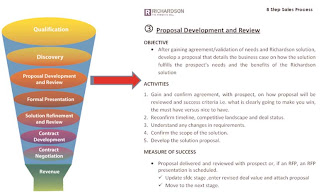
A good way to understand this is to look at an example. If you have an Eight-Step Sales Process, it should be embedded in your CRM system where your Salespeople are held accountable for following the process and entering the necessary data that is required to manage opportunities. This provides your team with the consistency in both behavior and data gathering that you need to improve your sales performance, forecasting, and success. As you can see in the example below, the process is embedded in the opportunity management screen where the Salespeople are held accountable for completing specific fields or “gates” of information before an opportunity can advance from one stage of the process to the next.
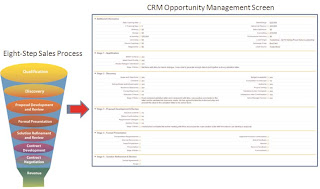 This creates a consistent opportunity management process and the required data for improved deal, pipeline, and revenue forecasting. But just building process and functionality into the screens is not enough. Your team members need training on how to follow the process, use the new screens, and understand the data requirements to grasp how all of this will benefit them directly.
Technology
Your CRM system more than likely does a good job of managing customers and opportunities – keeping current contact data, scheduling of events, and tracking specifics of opportunities. But does it also offer integrated sales tools that help Salespeople to accelerate opportunities, plan for client meetings, collaborate with their team members, and be coached by their Managers – all supporting your sales process and methodology? These additional technology tools allow them to hit their personal goals of getting to quota, going to club, and flat out making good money - thus giving your team members the value they need to see to want to use your CRM system.
Here are some best-practice examples of technology tools that can be integrated into your existing CRM system:
A Sales Call Planner. This particular tool is used for Salespeople to prepare for and execute successful sales meetings. It is supported by a best-practice sales methodology, embedded learning assets, and is delivered on a platform that allows Sales Managers to provide pre- and post-meeting coaching.
An Opportunity Accelerator. This technology tool is used in conjunction with the Sales Call Planner to ensure that Salespeople are following a best-practice sales process, have a tool to manage the strategy of an opportunity, and are able to collaborate with a deal team or their Manager on the execution of the opportunity.
People and Data
By having your sales process and methodology embedded in your CRM and providing technology tools to enhance value, your Salespeople will begin to change their behavior in how they use the CRM system. Additional training needs to be supplied to your people that will allow them to understand their business. When the proper process and tools are in place, and training and coaching have been delivered, your CRM system will start generating data that, when properly reported, will give you and your team insight into how everyone should be managing their business – or better said, their pipeline.
Providing reports centered on the sales process and how opportunities are flowing through the process are an important part of adding the final “value” to your Salespeople. This will allow them to see how their behaviors are affecting their business. This requires the reporting of key analytics that are then provided to your Salespeople and your Sales Managers that will allow them to see patterns in sales behaviors that need to be changed through additional training and coaching.
Let’s take a look at what a baseline list of these pipeline management analytics should be.
If your Salespeople do not have access to their key CRM metrics, they will not know how their behaviors are impacting their business. They will also not know how to properly forecast and develop the necessary action steps needed to improve their personal pipeline.
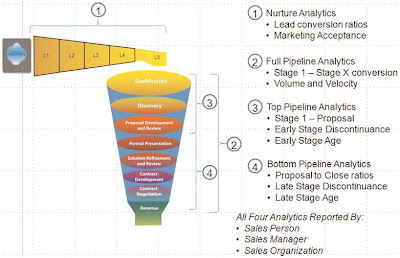 If we go back to our Eight-Stage Pipeline graphic (shown below), we can look at the main ways that Salespeople should manage their business. First, they should manage the prospecting and nurturing of leads – as shown in the L1-L5 section #1 of the pipeline graphic. This depicts a five-stage lead nurture process that is either driven by Marketing, Inside Sales, or the Field Sales Team. These are the leads that come into your company that are not yet qualified to be added to your pipeline. There are two key analytics that your Salespeople need to learn about these leads: their lead conversion ratios (how many leads make it to the pipeline) and their acceptance performance against leads that are provided to them by their Sales Team.
In section #2 of the pipeline graphic, the Sales Team needs to know their full pipeline conversion information (how many opportunities enter the pipeline in the first stage and conclude in sales). They also need to see the volume of what they are entering and the velocity (how fast) they move through the pipeline. This data needs to be compiled for each stage of the sales process.
The next set of analytics exist in sections #3 and #4 of the pipeline graphic. It is important to have analytics for the top and the bottom of your pipeline. Not all Salespeople are good at prospecting (hunters) and closing or managing accounts (farmers). It is important to understand individual performance levels in each section. With this data in hand and with each Salesperson trained on how to read and understand their personal analytics, Managers will be able to collaborate with their team members to coach against the sales process and pipeline behavior. This will drive consistency, better forecasting, and improved opportunity execution for your overall Sales Team and individual Salespeople.
By combining an embedded best-practice sales process and methodology, tools to support the process, and the reporting and management of pipeline performance, you will have developed a revenue management system that will help you to achieve your corporate and personal goals.
How Can Richardson Help?
The Richardson Sales Readiness Service focuses on helping you develop and implement best practice sales processes and methodologies that drive the consistency and efficiency of your Sales Team. We will also work with you to build the necessary KPIs and embed it all in your CRM system so it can be reported, tracked, and managed. Our Pipeline Management courses build the business knowledge your Sales Team members need in order to improve how they manage their business and deliver your Managers the skills they need to coach to pipeline improvement.
To sustain behavior change, Richardson offers CRM-integrated tools that become part or your team’s everyday workflow and drive the consistency you need to succeed.
Visit Richardson’s website at www.richardson.com for more information on how Richardson’s Sales Readiness Service can help your Sales Organization reach their objectives.
Let's now continue this discussion.
CRM systems don’t come with a best practice sales process and methodology. A sales process is the steps that your Salespeople take from prospecting to closing an opportunity, to then managing and expanding that account. A methodology is the combined “what” the Salespeople will do in each step of your process to achieve the desired results.

A good way to understand this is to look at an example. If you have an Eight-Step Sales Process, it should be embedded in your CRM system where your Salespeople are held accountable for following the process and entering the necessary data that is required to manage opportunities. This provides your team with the consistency in both behavior and data gathering that you need to improve your sales performance, forecasting, and success. As you can see in the example below, the process is embedded in the opportunity management screen where the Salespeople are held accountable for completing specific fields or “gates” of information before an opportunity can advance from one stage of the process to the next.
 This creates a consistent opportunity management process and the required data for improved deal, pipeline, and revenue forecasting. But just building process and functionality into the screens is not enough. Your team members need training on how to follow the process, use the new screens, and understand the data requirements to grasp how all of this will benefit them directly.
 Technology
Your CRM system more than likely does a good job of managing customers and opportunities – keeping current contact data, scheduling of events, and tracking specifics of opportunities. But does it also offer integrated sales tools that help Salespeople to accelerate opportunities, plan for client meetings, collaborate with their team members, and be coached by their Managers – all supporting your sales process and methodology? These additional technology tools allow them to hit their personal goals of getting to quota, going to club, and flat out making good money - thus giving your team members the value they need to see to want to use your CRM system.
Here are some best-practice examples of technology tools that can be integrated into your existing CRM system:
A Sales Call Planner. This particular tool is used for Salespeople to prepare for and execute successful sales meetings. It is supported by a best-practice sales methodology, embedded learning assets, and is delivered on a platform that allows Sales Managers to provide pre- and post-meeting coaching.
An Opportunity Accelerator. This technology tool is used in conjunction with the Sales Call Planner to ensure that Salespeople are following a best-practice sales process, have a tool to manage the strategy of an opportunity, and are able to collaborate with a deal team or their Manager on the execution of the opportunity.
People and Data
By having your sales process and methodology embedded in your CRM and providing technology tools to enhance value, your Salespeople will begin to change their behavior in how they use the CRM system. Additional training needs to be supplied to your people that will allow them to understand their business. When the proper process and tools are in place, and training and coaching have been delivered, your CRM system will start generating data that, when properly reported, will give you and your team insight into how everyone should be managing their business – or better said, their pipeline.
Providing reports centered on the sales process and how opportunities are flowing through the process are an important part of adding the final “value” to your Salespeople. This will allow them to see how their behaviors are affecting their business. This requires the reporting of key analytics that are then provided to your Salespeople and your Sales Managers that will allow them to see patterns in sales behaviors that need to be changed through additional training and coaching.
Let’s take a look at what a baseline list of these pipeline management analytics should be.
If your Salespeople do not have access to their key CRM metrics, they will not know how their behaviors are impacting their business. They will also not know how to properly forecast and develop the necessary action steps needed to improve their personal pipeline.
 If we go back to our Eight-Stage Pipeline graphic (shown below), we can look at the main ways that Salespeople should manage their business. First, they should manage the prospecting and nurturing of leads – as shown in the L1-L5 section #1 of the pipeline graphic. This depicts a five-stage lead nurture process that is either driven by Marketing, Inside Sales, or the Field Sales Team. These are the leads that come into your company that are not yet qualified to be added to your pipeline. There are two key analytics that your Salespeople need to learn about these leads: their lead conversion ratios (how many leads make it to the pipeline) and their acceptance performance against leads that are provided to them by their Sales Team.
In section #2 of the pipeline graphic, the Sales Team needs to know their full pipeline conversion information (how many opportunities enter the pipeline in the first stage and conclude in sales). They also need to see the volume of what they are entering and the velocity (how fast) they move through the pipeline. This data needs to be compiled for each stage of the sales process.
The next set of analytics exist in sections #3 and #4 of the pipeline graphic. It is important to have analytics for the top and the bottom of your pipeline. Not all Salespeople are good at prospecting (hunters) and closing or managing accounts (farmers). It is important to understand individual performance levels in each section. With this data in hand and with each Salesperson trained on how to read and understand their personal analytics, Managers will be able to collaborate with their team members to coach against the sales process and pipeline behavior. This will drive consistency, better forecasting, and improved opportunity execution for your overall Sales Team and individual Salespeople.
By combining an embedded best-practice sales process and methodology, tools to support the process, and the reporting and management of pipeline performance, you will have developed a revenue management system that will help you to achieve your corporate and personal goals.
How Can Richardson Help?
The Richardson Sales Readiness Service focuses on helping you develop and implement best practice sales processes and methodologies that drive the consistency and efficiency of your Sales Team. We will also work with you to build the necessary KPIs and embed it all in your CRM system so it can be reported, tracked, and managed. Our Pipeline Management courses build the business knowledge your Sales Team members need in order to improve how they manage their business and deliver your Managers the skills they need to coach to pipeline improvement.
To sustain behavior change, Richardson offers CRM-integrated tools that become part or your team’s everyday workflow and drive the consistency you need to succeed.
Visit Richardson’s website at www.richardson.com for more information on how Richardson’s Sales Readiness Service can help your Sales Organization reach their objectives.
Thursday, August 12, 2010
Your CRM or Your Salespeople? Understanding CRM Performance Beyond Just Features and Functionality
A CRM system is much more than just customer relationship management. CRM systems have become the “work stream” whereby revenue management happens. So, your CRM system is really a revenue management system. Customer relationship management, though extremely important, is now a sub-activity in the overall requirement of managing revenue.
CRM systems are now a big part of every Salesperson’s day. It’s their workflow. The CRM is the freeway that enables the management of the lifeblood of your company – your sales. As a Sales Manager, you get this. As a Salesperson, you might not get this. Why? The value seen by using a CRM system has typically been at the Manager and Executive level – many times, the value does not make it to the field level.
If you are experiencing poor CRM adoption, corrupt client and forecasting data, and an overall feeling by your Sales Team that your CRM system is just flat out broken, it might not be your CRM system that is causing the problems. It could be you and your people. When a company purchases a CRM system, many times, 95% of the budget is spent on the technology and only 5% on the training of the users. Why? Because the technology is the most tangible part of the solution...but it only comprises 20% of the solution. The other 80% of the solution is not so tangible.
That 80% is made up of people and process. A CRM system is only as good as the people using it and the processes they need to follow. If the behaviors of your Salespeople are not aligned to a consistent process and specific expectations, then it does not matter how great your CRM system is, your people will not effectively use it.
To improve the effectiveness of your CRM system, focus on four things: Process, Technology, People, and Data.
Process
CRM systems don’t come with a best practice sales process and methodology. A sales process is the steps that your Salespeople take from prospecting to closing an opportunity, to then managing and expanding that account. A methodology is the combined “what” the Salespeople will do in each step of your process to achieve the desired results.
In the next two weeks, I will post more thoughts on this topic and cover the remaining sections about technology, people and data.
Thanks for your time.
CRM systems are now a big part of every Salesperson’s day. It’s their workflow. The CRM is the freeway that enables the management of the lifeblood of your company – your sales. As a Sales Manager, you get this. As a Salesperson, you might not get this. Why? The value seen by using a CRM system has typically been at the Manager and Executive level – many times, the value does not make it to the field level.
If you are experiencing poor CRM adoption, corrupt client and forecasting data, and an overall feeling by your Sales Team that your CRM system is just flat out broken, it might not be your CRM system that is causing the problems. It could be you and your people. When a company purchases a CRM system, many times, 95% of the budget is spent on the technology and only 5% on the training of the users. Why? Because the technology is the most tangible part of the solution...but it only comprises 20% of the solution. The other 80% of the solution is not so tangible.
That 80% is made up of people and process. A CRM system is only as good as the people using it and the processes they need to follow. If the behaviors of your Salespeople are not aligned to a consistent process and specific expectations, then it does not matter how great your CRM system is, your people will not effectively use it.
To improve the effectiveness of your CRM system, focus on four things: Process, Technology, People, and Data.
Process
CRM systems don’t come with a best practice sales process and methodology. A sales process is the steps that your Salespeople take from prospecting to closing an opportunity, to then managing and expanding that account. A methodology is the combined “what” the Salespeople will do in each step of your process to achieve the desired results.
In the next two weeks, I will post more thoughts on this topic and cover the remaining sections about technology, people and data.
Thanks for your time.
Tuesday, June 8, 2010
Sales Behavior and Your Sales Pipeline
So the other day, our marketing team came to me with an idea for a pipeline management video. They wanted to try a new green screen that they ordered and could not think of a better and more willing victim than me.
So, I jumped in head first and here is a link to a video about how your sales behavior impacts your sales pipeline. Enjoy. Oh, the camera does add 5 pounds!!!
http://www.youtube.com/watch?v=cGJ0ALaoQs8
So, I jumped in head first and here is a link to a video about how your sales behavior impacts your sales pipeline. Enjoy. Oh, the camera does add 5 pounds!!!
http://www.youtube.com/watch?v=cGJ0ALaoQs8
Friday, April 30, 2010
Warm call - it still works
The phone is not dead. At least my phone is not dead. A balanced demand generation strategy should leverage all media channels - as you never know which media a person will respond to. Let's talk about the phone for a moment.
Yep - it's that old piece of technology that is still on your desk. Probably has dust on it and is surrounded by those stacks of paper that you have been meaning to read for the past year. Well, put that bad boy right back in front of you, dust it off and introduce it to your computer. They are a match made in heaven.
The following is not a new tactic by any means. It's one that still works. But the success is all in the execution. This is a refresher. Take a read....
1. Send out 75 emails a week to prospects and dormant clients. You should include a solid educational asset that is not a product pitch and one that helps the recipient do their job better.
2. Plan a dialogue that you want to have with these contacts. This is not a script, but think through what you are going to say to the contact. How are you going to open the conversation? What questions are you going to ask? What new idea or value are you going to position? What objections can you foresee and how are you going to over come them? How are you going to close - what will give value to the contact and what do you want as the next step?
3. Expect that it may take you 5-7 attempts to reach the person. Don't give up after the first try.
What results can you expect? If you send out 100 emails, you can expect 3-5 of those people to actually read the asset that you sent. That's why you need to call them. By adding your old friend the phone to the mix, you will most likely up that to 15-20. Of those 15-20, you should expect 5-7 to engage you in meaningful dialogues and most should result in pipeline opportunity. If your average deal size is $50K, then you probably just got yourself $250K plus in early stage pipeline.
Now, where this breaks down is in the phone follow up. You have to dedicate yourself to dialing that phone. Set aside regular time to do it. If you do not, then your busy and hectic day will kill your ability to turn this tactic in to a effective way to build pipeline.
Hope this helps you.
To Learn more about Richardson's sales training and sales performance improvement solutions, please visit us on the web at http://www.richardson.com
Yep - it's that old piece of technology that is still on your desk. Probably has dust on it and is surrounded by those stacks of paper that you have been meaning to read for the past year. Well, put that bad boy right back in front of you, dust it off and introduce it to your computer. They are a match made in heaven.
The following is not a new tactic by any means. It's one that still works. But the success is all in the execution. This is a refresher. Take a read....
1. Send out 75 emails a week to prospects and dormant clients. You should include a solid educational asset that is not a product pitch and one that helps the recipient do their job better.
2. Plan a dialogue that you want to have with these contacts. This is not a script, but think through what you are going to say to the contact. How are you going to open the conversation? What questions are you going to ask? What new idea or value are you going to position? What objections can you foresee and how are you going to over come them? How are you going to close - what will give value to the contact and what do you want as the next step?
3. Expect that it may take you 5-7 attempts to reach the person. Don't give up after the first try.
What results can you expect? If you send out 100 emails, you can expect 3-5 of those people to actually read the asset that you sent. That's why you need to call them. By adding your old friend the phone to the mix, you will most likely up that to 15-20. Of those 15-20, you should expect 5-7 to engage you in meaningful dialogues and most should result in pipeline opportunity. If your average deal size is $50K, then you probably just got yourself $250K plus in early stage pipeline.
Now, where this breaks down is in the phone follow up. You have to dedicate yourself to dialing that phone. Set aside regular time to do it. If you do not, then your busy and hectic day will kill your ability to turn this tactic in to a effective way to build pipeline.
Hope this helps you.
To Learn more about Richardson's sales training and sales performance improvement solutions, please visit us on the web at http://www.richardson.com
Wednesday, April 21, 2010
Why is it so difficult?
I just came back from a business leadership event. The attendees were mostly sales executives. There was a session at that event around improving sales and marketing alignment. It was a panel discussion and the first question the moderator asked the panel was "Why is sales and marketing alignment so difficult/hard?".
The panel and the audience did not find it difficult to answer. The answers were all across the spectrum from lack of communication, behaviors, process to compensation modeling. What became difficult in the session was getting clear direction and understanding on what to do about it.
As a participant in the audience, I felt as though the panel really struggled with this topic. The attendees and panel never really got beyond the old "sales vs. marketing" dilemma. It did not help the cause when the moderator asked the question "What about that other (your sales or marketing) person frustrates you and why".
Near the end of the discussion, the panel was starting to put some meat on the bone with some content around aligning KPI, tighter accountability, and having a strong process. But these are solutions to symptoms of the problem and not to the overall problem at hand.
It would have been great if they would have talked about "one team, one goal". No longer should it be sales and marketing teams - but looked at as one revenue generation team. Frank, are you saying that there should no longer be "marketing"? Nope, that's not what I'm saying. There needs to be branding, advertising, public relations and the other very important parts of our marketing operations. That's not the part of marketing we are talking about. We are talking about the part that is responsible for demand generation - filling that pipeline.
Revenue generation is like a relay race. Every team member is accountable for their role in the process - from the first runner (generating responders/leads) to the last runner (the last few stages of your pipeline). The hand offs of the baton (lead or opportunity) need to be flawless. In the end, it's about winning the race and everyone has a vested interest in winning that race. If not, the whole team loses. And that's not difficult to understand.
For more information on sales and marketing alignment, please read the rest of this blog if you have not yet done so. Tons of tips and other great stuff are buried in that copy.
---------------------------------------------------------------------------
To Learn more about Richardson's sales training and sales performance improvement solutions, please visit us on the web at http://www.richardson.com
The panel and the audience did not find it difficult to answer. The answers were all across the spectrum from lack of communication, behaviors, process to compensation modeling. What became difficult in the session was getting clear direction and understanding on what to do about it.
As a participant in the audience, I felt as though the panel really struggled with this topic. The attendees and panel never really got beyond the old "sales vs. marketing" dilemma. It did not help the cause when the moderator asked the question "What about that other (your sales or marketing) person frustrates you and why".
Near the end of the discussion, the panel was starting to put some meat on the bone with some content around aligning KPI, tighter accountability, and having a strong process. But these are solutions to symptoms of the problem and not to the overall problem at hand.
It would have been great if they would have talked about "one team, one goal". No longer should it be sales and marketing teams - but looked at as one revenue generation team. Frank, are you saying that there should no longer be "marketing"? Nope, that's not what I'm saying. There needs to be branding, advertising, public relations and the other very important parts of our marketing operations. That's not the part of marketing we are talking about. We are talking about the part that is responsible for demand generation - filling that pipeline.
Revenue generation is like a relay race. Every team member is accountable for their role in the process - from the first runner (generating responders/leads) to the last runner (the last few stages of your pipeline). The hand offs of the baton (lead or opportunity) need to be flawless. In the end, it's about winning the race and everyone has a vested interest in winning that race. If not, the whole team loses. And that's not difficult to understand.
For more information on sales and marketing alignment, please read the rest of this blog if you have not yet done so. Tons of tips and other great stuff are buried in that copy.
---------------------------------------------------------------------------
To Learn more about Richardson's sales training and sales performance improvement solutions, please visit us on the web at http://www.richardson.com
Subscribe to:
Posts (Atom)
